Session 01-02 - Language, Sets, and Number Systems
Section 01: Mathematical Foundations & Algebra
Entry Quiz
Quick Morning Check
Complete on paper - we’ll review together
- Calculate: \(\frac{2}{3} + \frac{3}{4}\)
- Simplify: \(x^2 \cdot x^3\) (write each power as a product)
- What is 15% of 240?
- Solve: \(|x| = 5\) (\(|x|\) is the distance of \(x\) from zero)
Ready? Let’s see how you did!
Learning Objectives
Learning Objectives
By the end of this session, you can:
- Classify numbers within the hierarchy \(\mathbb{N} \subset \mathbb{Z} \subset \mathbb{Q} \subset \mathbb{R}\)
- Read and write sets in roster, set-builder, and interval notation
- Perform set operations and visualize them with Venn diagrams
- Apply the commutative, associative, and distributive properties
- Compute percentages and compound growth for business problems
- Read basic logical statements and truth tables
Number Systems
The Number Hierarchy
\[\mathbb{N} \subset \mathbb{Z} \subset \mathbb{Q} \subset \mathbb{R}\]
- \(\mathbb{N}\) = {1, 2, 3, …} Natural numbers
- \(\mathbb{Z}\) = {…, -2, -1, 0, 1, 2, …} Integers
- \(\mathbb{Q}\) = \(\{\frac{p}{q} : p, q \in \mathbb{Z}, q \neq 0\}\) Rationals
- \(\mathbb{I}\) = Numbers that cannot be expressed as fractions Irrationals
- \(\mathbb{R}\) = All points on the number line Reals
Some books include 0 in \(\mathbb{N}\). In this course, \(\mathbb{N} = \{1, 2, 3, ...\}\). The set with zero is denoted \(\mathbb{N}_0\). The irrationals \(\mathbb{I}\) sit beside \(\mathbb{Q}\) inside \(\mathbb{R}\): no number is both rational and irrational!
Picturing the Hierarchy
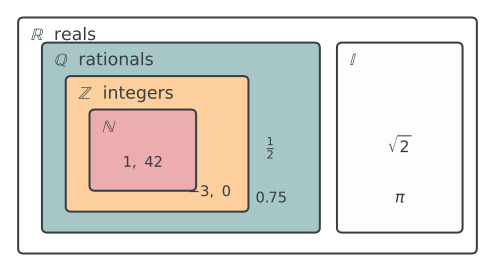
Every natural number is an integer, every integer is rational, but \(\sqrt{2}\) and \(\pi\) live outside \(\mathbb{Q}\), in the irrationals.
Set Theory Basics
What is a Set?
A set is a well-defined collection of distinct objects.
Notation:
- Roster: \(A = \{1, 2, 3, 4, 5\}\)
- Set-builder: \(B = \{x \in \mathbb{N} : x < 6\}\)
- Interval: \(C = [0; 1] = \{x \in \mathbb{R} : 0 \leq x \leq 1\}\)
Common Mistake
\(\{1, 2, 2, 3\} = \{1, 2, 3\}\). Sets contain only distinct elements!
Interval Notation
Interval notation uses brackets and parentheses to show whether endpoints are included or excluded:
- Closed: \([a; b] = \{x \in \mathbb{R} : a \leq x \leq b\}\), both endpoints included
- Open: \((a; b) = \{x \in \mathbb{R} : a < x < b\}\), both endpoints excluded
- Half-open: \([a; b)\) includes \(a\), excludes \(b\); \((a; b]\) excludes \(a\), includes \(b\)
The FSP writes intervals with a semicolon, e.g. \([2; 5]\), because it uses the decimal comma. We do the same.
Square bracket \([\) means “included”, round parenthesis \((\) means “excluded”. Think of it as the bracket “grabbing” the endpoint!
Intervals on the Number Line
![Three number lines, each marking the stretch from -2 to 3: the closed interval [-2; 3] has two filled endpoint dots, the open interval (-2; 3) two hollow dots, and the half-open interval [-2; 3) a filled dot at -2 and a hollow dot at 3.](lecture-01-02_files/figure-revealjs/cell-4-output-1.svg)
A filled dot means the endpoint belongs to the interval, an open dot means it does not.
Math Language
Why Mathematical Notation?
Mathematics is a universal language that allows us to:
- Express complex ideas precisely
- Communicate without ambiguity
- Solve problems systematically
- Build logical arguments
Clear notation prevents costly misunderstandings in contracts, financial models, and data analysis.
Essential Symbols - Sets
| Symbol | Meaning | Example |
|---|---|---|
| \(\in\) | Element of | \(3 \in \mathbb{N}\) |
| \(\notin\) | Not element of | \(\pi \notin \mathbb{Q}\) |
| \(\subset\) | Subset (all of \(A\) is in \(B\), \(A \neq B\)) | \(\mathbb{N} \subset \mathbb{Z}\) |
| \(\subseteq\) | Subset or equal | \(A \subseteq A\) |
| \(\cup\) | Union | \(A \cup B\) |
| \(\cap\) | Intersection | \(A \cap B\) |
| \(\emptyset\) | Empty set | \(A \cap B = \emptyset\) |
Essential Symbols - Logic
| Symbol | Meaning | Example |
|---|---|---|
| \(\forall\) | For all | \(\forall x \in \mathbb{R}: x^2 \geq 0\) |
| \(\exists\) | There exists | \(\exists x \in \mathbb{Z}: x < 0\) |
| \(\Rightarrow\) | Implies | \(x = 2 \Rightarrow x^2 = 4\) |
| \(\Leftrightarrow\) | If and only if | \(x^2 = 4 \Leftrightarrow x = \pm 2\) |
| \(\neg\) | Not | \(\neg (x > 0)\) means \(x \leq 0\) |
| \(\wedge\) | And | \(p \wedge q\) |
| \(\vee\) | Or | \(p \vee q\) |
Let’s Practice Reading
Translate to English:
- \(\forall x \in \mathbb{R}: x + 0 = x\)
- “For all real numbers x, x plus zero equals x”
- \(\exists n \in \mathbb{N}: n > 1000000\)
- “There exists a natural number n greater than one million”
- \(x \in A \cap B \Rightarrow x \in A\)
- “If x is in the intersection of A and B, then x is in A”
Let’s Practice Reading II
What do these sets contain? Formulate a sentence:
- \(\{x \in \mathbb{N} : x = 5k \text{ for some } k \in \mathbb{N} \text{ and } x \leq 50\}\)
- “The set of all natural numbers that are multiples of 5 and at most 50”
- \(\{x \in \mathbb{R} : x^2 - 4 = 0 \text{ or } x > 10\}\)
- “The set of all real numbers that solve \(x^2 - 4 = 0\) (so \(2\) and \(-2\)) or are greater than 10”
“For some \(k\)” and “\(\exists k\)” (there exists a \(k\)) mean the same thing.
Individual Exercise 01
Work individually for 5 minutes, then compare with neighbors
Express the following in set notation (choose which notation to use):
- The set of all even natural numbers
- The set of all real numbers between -1 and 1 (inclusive)
- The set of all integers divisible by 3
Break
Numbers & Sets
Venn Diagrams
Venn diagrams are visual representations of sets and their relationships: the rectangle is the universal set \(U\), each circle is a set.
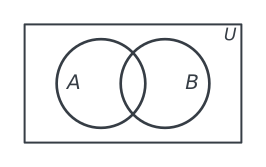
Venn diagrams help visualize complex set relationships!
Union
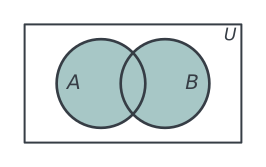
Union: \(A \cup B\), all elements in A or B (or both)
Example: \(\{1,2\} \cup \{2,3\} = \{1,2,3\}\)
Intersection
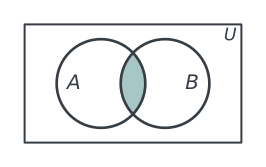
Intersection: \(A \cap B\), all elements in A and B
Example: \(\{1,2\} \cap \{2,3\} = \{2\}\)
Difference
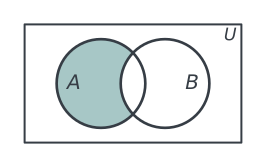
Difference: \(A \setminus B\), elements in A but not in B
Example: \(\{1,2,3\} \setminus \{2,3\} = \{1\}\)
Complement
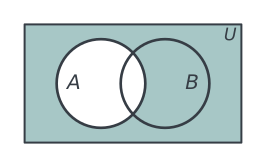
Complement: \(\bar{A}\), all elements of \(U\) not in A
Requires a universal set \(U\)!
Example: Employee Skills
A company tracks employee skills:
- \(P\) = {Python, Java, SQL, R}
- \(D\) = {SQL, Excel, Tableau, R}
Lets work together and find the following:
- \(P \cup D\) (All skills available)
- \(P \cap D\) (Versatile skills)
- \(P \setminus D\) (Skills unique to Programmers)
- \(D \setminus P\) (Skills unique to Data Analysts)
Classifying Numbers
Classify \(\frac{22}{7}\)
- Can be written as \(\frac{p}{q}\) ✓
- Therefore: \(\frac{22}{7} \in \mathbb{Q}\)
- Also: \(\frac{22}{7} \in \mathbb{R}\)
- But: \(\frac{22}{7} \notin \mathbb{Z}\) (≈ 3.14…)
Classify \(\sqrt{9}\)
- \(\sqrt{9} = 3\)
- Therefore: \(3 \in \mathbb{N}\)
- Also: \(3 \in \mathbb{Z}, \mathbb{Q}, \mathbb{R}\)
Be careful! \(\pi \approx \frac{22}{7}\) but \(\pi \neq \frac{22}{7}\)
- \(\pi\) is irrational!
- No fraction exactly equals \(\pi\)
What about the following?
Is \(0.\overline{45}\) rational?
Let \(x = 0.454545...\)
- Multiply by 100: \(100x = 45.454545...\)
- Subtract original: \(100x - x = 45.454545... - 0.454545...\)
- Simplify: \(99x = 45\)
- Solve: \(x = \frac{45}{99} = \frac{5}{11}\)
Yes! It’s rational.
For \(0.\overline{abc}\) with n repeating digits:
- Multiply by \(10^n\)
- Subtract original
- Solve for x
Group Exercise 01
Work in pairs for 5 minutes
Of 60 students, 35 study Mathematics, 28 study Economics and 12 study both.
Using set notation and a Venn diagram, find:
- How many study at least one subject?
- How many study only Mathematics?
We are going to do this one together. Any suggestions on how to start?
Individual Exercise 02
Work individually for 5 minutes
Classify each (list ALL applicable sets):
- \(-\frac{8}{2}\)
- \(\sqrt{7}\)
- \(0.\overline{55}\)
- \(\pi + 1\)
Hint: The square root of a natural number that is not a square number (such as 1, 4, 9) is irrational, and an irrational number plus a rational number is irrational.
Coffee Break
Operation Properties
The Big Three Properties
Commutative: Order doesn’t matter
- \(a + b = b + a\)
- \(a \times b = b \times a\)
Associative: Grouping doesn’t matter
- \((a + b) + c = a + (b + c)\)
- \((a \times b) \times c = a \times (b \times c)\)
Distributive: Multiplication distributes over addition
- \(a(b + c) = ab + ac\)
Business Application
Revenue Calculation
A store sells 3 products:
- Product A: 50 units at 20 EUR each
- Product B: 30 units at 20 EUR each
- Product C: 40 units at 20 EUR each
\((50 × 20) + (30 × 20) + (40 × 20)\)
\(20 × (50 + 30 + 40)\) Distributive property!
- Remember: multiplication before addition!
Which Operations Commute?
| Operation | Commutative? | Example |
|---|---|---|
| Addition | ✓ Yes | \(3 + 5 = 5 + 3 = 8\) |
| Multiplication | ✓ Yes | \(3 × 5 = 5 × 3 = 15\) |
| Subtraction | ✗ No | \(5 − 3 ≠ 3 − 5\) |
| Division | ✗ No | \(6 ÷ 2 ≠ 2 ÷ 6\) |
| Exponentiation | ✗ No | \(2^3 ≠ 3^2\) |
Common Mistake
Students somtimes assume all operations commute!
Percentage Calculations
Finding x% of a number:
\(\text{Result} = \frac{x}{100} \times \text{Base}\)
- Example: 15% of 240
- Solution: 15% of 240 = \(\frac{15}{100} \times 240 = 36\)
Finding the change:
\(\text{Change \%} = \frac{\text{New} - \text{Old}}{\text{Old}} \times 100\%\)
- Example: From 5000 EUR to 5500 EUR
- Solution: \(\frac{5500-5000}{5000} \times 100\% = 10\%\)
Multiple periods:
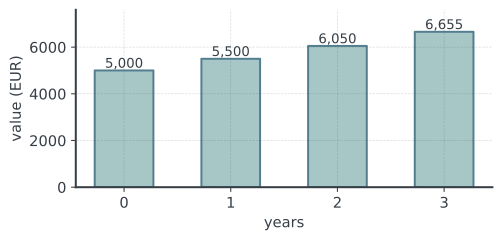
\(\text{Final} = \text{Initial} \times (1 + r)^n\)
- Where r = rate (as decimal), n = periods
- Example: 5000 EUR at 10% for 3 years
- Solution: \(5000 \times (1.10)^3 = 6655\text{ EUR}\)
Compound Growth Visualized
5000 EUR growing at 10% per year:
Logic Basics
Truth Tables for \(p\) and \(q\)
| \(p\) | \(q\) | \(p \wedge q\) (and) | \(p \vee q\) (or) | \(p \Rightarrow q\) (imp.) |
|---|---|---|---|---|
| T | T | T | T | T |
| T | F | F | T | F |
| F | T | F | T | T |
| F | F | F | F | T |
Understanding Implication (\(p \Rightarrow q\))
Think of it as a promise: “If it is raining (\(p\)), then I will carry an umbrella (\(q\)).” The only way the promise is broken (the statement is False) is if it’s raining (\(p\)=T) but I don’t have my umbrella (\(q\)=F).
Soft Introduction to Proofs
A proof is a logical argument that shows a statement is true.
- The goal is to move from what we know (assumptions) to what we want to show (conclusion) using small, logical steps.
- A direct proof is the most common form:
- Assume \(p\) is true and show that \(q\) must logically follow.
No need to worry about this topic too much! We just cover the absolute basics here just for you to know what a proof is.
Practice Time
Group Exercise 02
Working in pairs, determine if these statements are true or false:
- \(\mathbb{Z} \subset \mathbb{Q}\)
- \(\sqrt{4} \in \mathbb{N}\)
- \(0.333... \in \mathbb{Q}\)
- \(\{1, 2\} \subset \{1, 2, 3\}\)
- \(\emptyset \subset \mathbb{N}\)
Take 5 minutes, then we’ll discuss!
Wrap-up
Key Takeaways
- Mathematical notation is precise and universal
- Venn diagrams visualize set relationships
- Number systems form a hierarchy: \(\mathbb{N} \subset \mathbb{Z} \subset \mathbb{Q} \subset \mathbb{R}\)
- Repeating decimals are rational numbers
- Operations have specific properties we can exploit
- Percentages and compound growth are essential for business
- Logic helps us reason systematically
Final Assessment
One quick check before you go:
To which number sets does \(-\frac{12}{4}\) belong?
And: what is \(\{1, 2, 3\} \setminus \{2, 3, 4\}\)?
Next Session Preview
Session 01-03: Core Algebra & Exponents
- Order of operations and algebraic expressions
- Laws of exponents and scientific notation
- Absolute value and basic factorization
Homework Assignment
Complete Tasks 01-02: set operations, number classification, proving/disproving properties, and prepare one presentation problem. Entry quiz next session on today’s material!
Session 01-02 - Language, Sets, and Number Systems | Dr. Nikolai Heinrichs & Dr. Tobias Vlćek | Home